
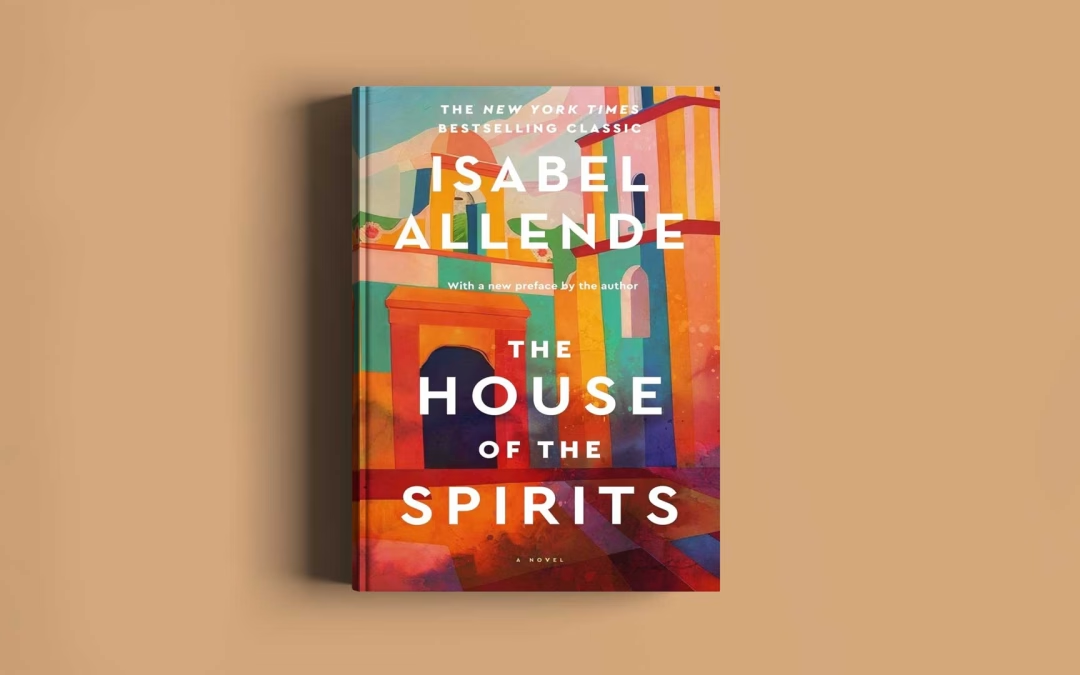
The Trueba family lives in a country that is never named but is, transparently, Chile. The story begins with Clara del Valle, a strange, clairvoyant child who can move objects across a room with her mind and who falls silent for nine years after watching the autopsy of her murdered sister. It moves through Clara's marriage to Esteban Trueba, a self-made landowner whose love for her is matched only by his appetite for power. It runs forward through three more generations: a daughter who falls for a peasant boy across a chasm of class, twin sons who choose opposite paths, and a granddaughter, Alba, who is born into privilege and into history at the same moment. By the last pages, the family will have lived through earthquakes, an election, a coup, and a reckoning that no one in the house could have predicted on the day Clara first spoke. Allende's first novel. One of the great family epics of the twentieth century.
About the Author
Isabel Allende was born in 1942 in Lima, Peru, into a Chilean diplomatic family. Her father's cousin, Salvador Allende, would later become the democratically elected president of Chile and would be killed in the 1973 military coup that brought General Augusto Pinochet to power. Isabel Allende fled Chile in 1975 and settled in Venezuela. She started writing this novel in 1981, when she received word that her hundred-year-old grandfather was dying. She began as a letter to him, hoping to set down everything she remembered about her family before it was gone, and somewhere in the writing the letter became a novel. The book was rejected by several Spanish-language publishers before a Barcelona house took it in 1982. It was an immediate sensation. It has been translated into more than twenty languages and has stayed continuously in print for over forty years. Allende has written more than twenty books since, including Of Love and Shadows, Eva Luna, Daughter of Fortune, and the memoir Paula, written for her daughter during a long illness. She received the Presidential Medal of Freedom in 2014. She lives in California and writes, by long custom, in Spanish.
Why It Endures
The House of the Spirits is openly in conversation with Gabriel García Márquez's One Hundred Years of Solitude, and Allende has never pretended otherwise. The family saga across generations, the unnamed Latin American country, the green-haired beauty, the matriarch with paranormal gifts, the political violence arriving like weather: the family resemblance is real. What Allende does that is hers alone is bring the women all the way to the front of the frame. One Hundred Years of Solitude is told largely through the Buendía men. The House of the Spirits is told through Clara, Blanca, and Alba, with Esteban Trueba alongside them as the second voice of the book, a self-made tyrant whose tenderness is reserved almost entirely for the women he keeps failing. The novel is also one of the most important pieces of literary witness to come out of the 1973 Chilean coup, and the final third of the book turns from family chronicle into something fiercer. Allende has said she did not want to write a political novel, exactly, but she could not write honestly about her own family and country without political violence arriving at the door. When it does, the book earns its weight. By the closing pages, Alba is writing the story you have just finished reading. That structural turn, that act of inheritance, is the reason the book has lasted.
"Absorbing and distinguished work. A unique achievement, both personal witness and possible allegory." — The New York Times Book Review
"An enthralling epic that spans decades and lives." — Publisher description
"Introduced Isabel Allende as one of the world's most gifted storytellers." — Publisher description
Before You Start
A few practical things. The House of the Spirits is around five hundred pages and built as a long, patient generational sweep. It is not a weekend book. It is a book to live with for a couple of weeks, ideally with a notebook on the side, because the family tree is large and the names within it repeat by design (Clara, Blanca, Alba, all of them words for white, all of them deliberately echoing one another across generations). Most editions include a family tree. Use it. The Magda Bogin translation is the standard English version and the one you will find in most bookstores. If this is your introduction to Allende, follow it with Eva Luna or Paula. If you want to read it in conversation with its sibling on the shelf, read One Hundred Years of Solitude first or after, in either order, and notice the differences as much as the resonances. Spanish-language readers should seek out the original La casa de los espíritus, which is, by every account, even more luminous than the translation. The 1993 film adaptation with Meryl Streep and Jeremy Irons exists. It is fine. The book is the thing.