
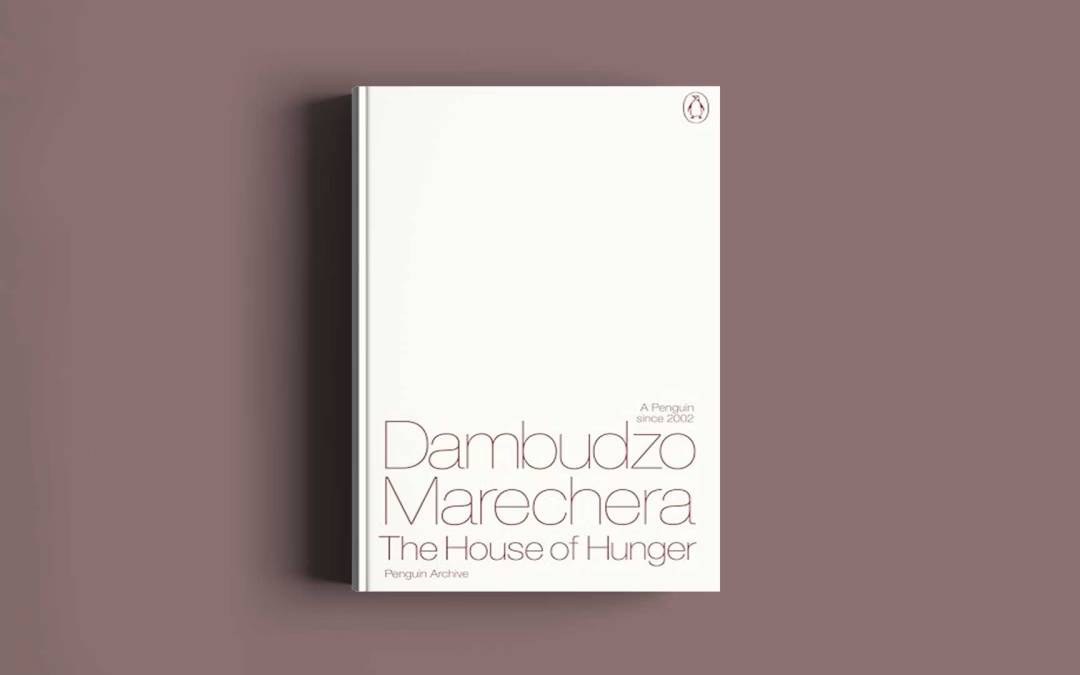
The House of Hunger by the Zimbabwean writer Dambudzo Marechera is like broken glass. You will not finish it cleanly. You will not be able to. The book will not let you, and the book does not want to.
Marechera published this slim volume in 1978 when he was twenty-six years old. He had just been thrown out of Oxford. He wrote much of it, by his own account, in a tent in a field outside the university while he was technically still enrolled. It won the Guardian Fiction Prize in 1979. He was the first African writer to win it. He showed up to the ceremony in a state that the British press did not know how to describe, and spent most of his short, blazing career being misunderstood on purpose and by accident in roughly equal measure. He died in 1987, at thirty-five, in Harare.
The House of Hunger is a novella followed by nine short stories, and the genre question is harder than usual. Some shelves call it literary fiction. Some call it postcolonial fiction. Some, with reasonable cause, call it experimental fiction, because the prose moves the way a fever moves, jumping forward and looping back and refusing to follow the chronology you would expect. The closest English-language comparison I can give you is the early work of writers like Sam Selvon or the angrier passages of James Baldwin, but the comparison falls short. Marechera was doing something the British and American canons were not doing. He sounds like himself, only and always.
The book is about how a young Black man comes of age in colonial Rhodesia in the 1960s and 1970s, in a country that is staggering toward what will become Zimbabwe. He is over-educated. He is alienated from his family. He is alienated from the nationalist movement that surrounds him. He is alienated from the colonial system that produced him. He drinks. He reads. He fights. He watches his brother and his friends and the women in his life suffer the daily violence of a country that has been built specifically to grind them down. The "house of hunger" of the title is his actual house. It is also his country. It is also his head. The book moves between all three without ever quite drawing the line.
The first line of the book is one of the most quoted opening lines in twentieth-century African literature, and I will not give it to you here. You deserve to meet it on the page yourself.
What I will give you, because Marechera gave it to us, is this. Early in the book the narrator says: "No, I don't hate being black. I'm just tired of saying it's beautiful." A few words later, he finishes the thought: "No, I don't hate myself. I'm just tired of people bruising their knuckles on my jaw." That voice, with all of its exhaustion and all of its refusal to perform, runs through the whole book. It is the voice of someone who has stopped trying to be palatable. It is also, often, very funny.
I will be honest about what reading this book is like. It is short. About 170 pages in most editions. You can finish it in two evenings. But the prose is dense in the way a poem is dense, and you will want to slow down. The novella moves between memory, hallucination, and waking life without flagging the transitions, the way a mind in distress actually moves. If you have read Bolaño you will recognize some of the rhythm. If you have read Beckett you will recognize some of the punctuation. If you have read neither, this is a fine place to start, because Marechera was reading both, and he is in conversation with them, and he is also unmistakably his own thing.