
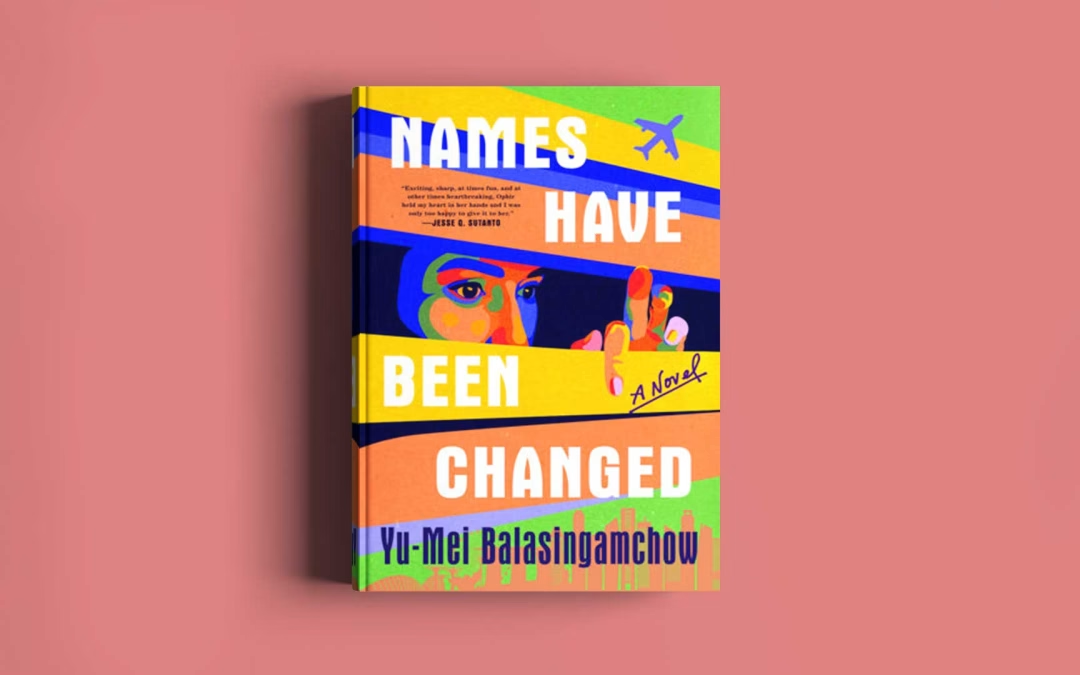
The debut novel by Singaporean write Yu-Mei Balasingamchow opens with a microphone and a confession.
A woman who calls herself Ophir, which is not her real name, has started a podcast. She is broadcasting from somewhere she will not say. She is going to tell you, episode by episode, about the years she has spent on the run. The crimes. The forged passports. The cities. The lovers. The reasons she left, and the reason she cannot go home.
What you are reading, in form, is a literary thriller built on a very old skeleton: the picaresque, the rogue's-progress novel that traces back to seventeenth-century Spain. NPR named it directly when they wrote that "this picaresque is off to a rocking start." Updated here with a podcast frame and a globally scattered cast of cities, but the bones are old and the bones are good. The publisher's elevator pitch is "Catch Me If You Can meets Counterfeit," and that pairing is more accurate than most. Kirstin Chen's Counterfeit and this book are reading each other across a small shelf.
The story begins in Singapore. A petty crime spins out of control. Whatever Ophir thought she was doing turns into something she cannot fix from inside her own life, so she leaves it. Estranged from family and home, she begins the long crisscross. She lands at a Paris-themed hostess bar in Tokyo. She lands at a busy Chinese restaurant in London. She lands in a snowbound mountain town in Colorado. She lands in other places too, and she moves through class lines with the ease of someone who has had to learn how to disappear into them. She is mixed-race, which, as she will tell you herself, helps with the passports.
The early reviews are striking. The book publishes on June 23, 2026, so most of what has come in so far is advance praise from trade journals and other novelists, but the list is hard to dismiss. A starred review in Kirkus called the book "an utterly original thieves' confession you won't be able to put down." Publishers Weekly called Ophir "an endlessly companiable narrator despite her patently unreliable version of events." Lisa Ko, the author of The Leavers, said the book "puts a sparkling new spin on the migration narrative." Ha Jin, who won the National Book Award for Waiting, called it "ingeniously conceived and written in an intelligent, fierce style." Vanessa Chan called it "a spiky, smart story about an itinerant Singaporean ex-con who yearns above all, to return."
This might be a debut novel, but Yu-Mei Balasingamchow has been publishing short fiction for years. Her stories have received a Pushcart Prize special mention and been shortlisted for the Commonwealth Prize. She has an MFA from Boston University. She was a bookseller at Papercuts in Boston, which is a detail I love. Booksellers who become novelists tend to write the kind of books other booksellers want to sell.
The podcast frame is the engine. Ophir is talking directly to a listener. You, reading the page, become that listener. The first-person voice does what good first-person voices do, which is to make you complicit. You will laugh in places you did not expect. You will catch her in a lie and keep listening anyway.