
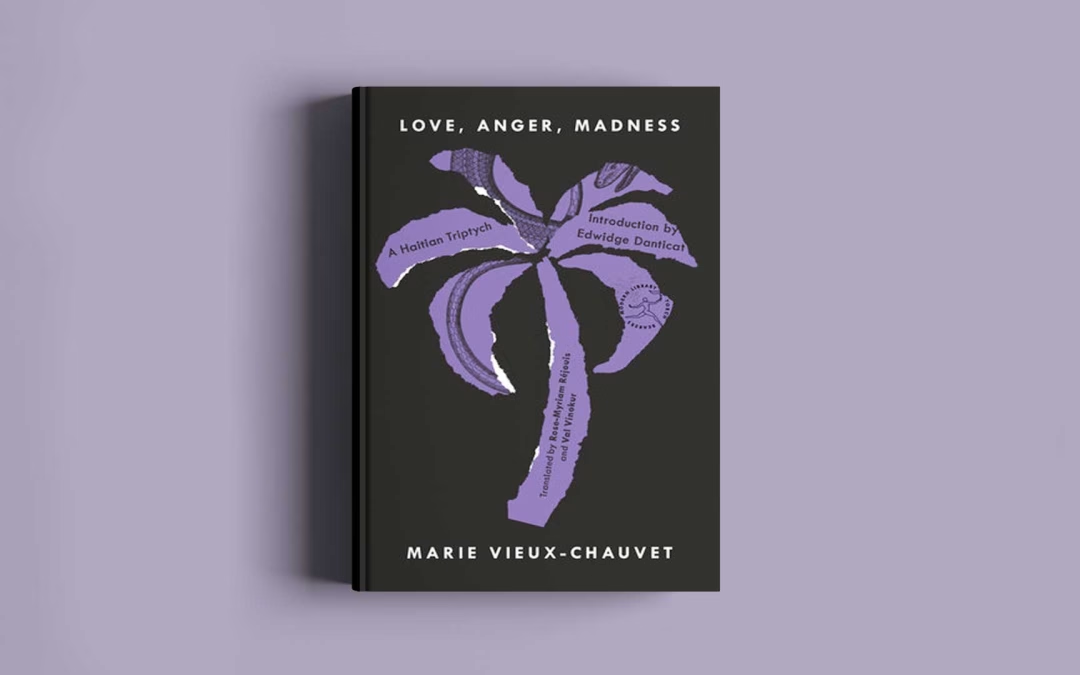
Some books almost did not survive. This is one of them.
Love, Anger, Madness is a trilogy of three short novels by the Haitian writer Marie Vieux-Chauvet, originally published in French as Amour, Colère et Folie in 1968. The book came out, ran into trouble almost immediately, and quietly disappeared from circulation within months. For nearly four decades it lived on photocopies and smuggled paperbacks. France finally reissued it in 2005. The Modern Library brought out this English translation by Rose-Myriam Réjouis and Val Vinokur in 2009, with an introduction by Edwidge Danticat. The translation was supported by a Simon Guggenheim Fellowship, which tells you something about the kind of labor it took to bring the book across into English.
This book is literary fiction, specifically a triptych of three linked novellas. They share a setting and a political climate but not characters. You can read them in order, which I would recommend, or you can read them as three separate books. Chauvet originally sent the three manuscripts to Simone de Beauvoir as three separate works. It was Beauvoir who told Éditions Gallimard to publish them together, and she was right. They speak to each other in ways no single novel could.
In Love. Claire is the eldest of three daughters in a fading provincial family. Her parents are dead. The household has fallen to her. She is the darkest-skinned of the three sisters, and she has spent her life carrying the weight of that fact. Her middle sister is married to a Frenchman named Jean Luze, and Claire keeps a diary in which she writes about him with an intensity that is hard to look at directly. Outside the house, a local police chief named Calédu is terrorizing the town. Claire watches everything and writes everything down.
In Anger. Men in black uniforms appear on the Normil family's land and announce that the land is no longer theirs. The grandfather refuses to leave. The father tries to fight through the courts and gets nowhere. Then a man from the lawyer's office, a man the family will come to call the Gorilla, names the price the family must actually pay. The father suggests that the daughter, Rose, is the only one who can pay it.
Finally, in Madness. A young poet named René is trapped in a small house in a Haitian village. Outside, paramilitaries he calls "the devils" have taken over the streets. There is no food. Other poets are with him, or seem to be. The dead are around him too, or seem to be. He is not sure anymore which is which.
That is as far as I will take you. What happens from there belongs to the reading.
The setting is barely fictionalized Haiti under François Duvalier, known as Papa Doc, and his paramilitary force the Tonton Macoute. Chauvet wrote the book while living inside that regime. She submitted it to her French publisher and to Beauvoir while still in Port-au-Prince. After the book was published and pulled, she left her husband, left Haiti, and moved to New York City, where she died of a brain tumor in 1973. She did not live to see her book come back. In 1986 it was posthumously awarded the Deschamps Prize, the major Haitian literary award. The English version you can buy today exists because her family, her translators, and her readers refused to let the book stay buried.
The book is roughly 400 pages in this edition, with the three novellas running roughly 200, 100, and 100 pages. Love is the longest and the most patient. Anger is the most direct. Madness is the most formally daring. Read them slowly. There is a lot of weather inside each one.