
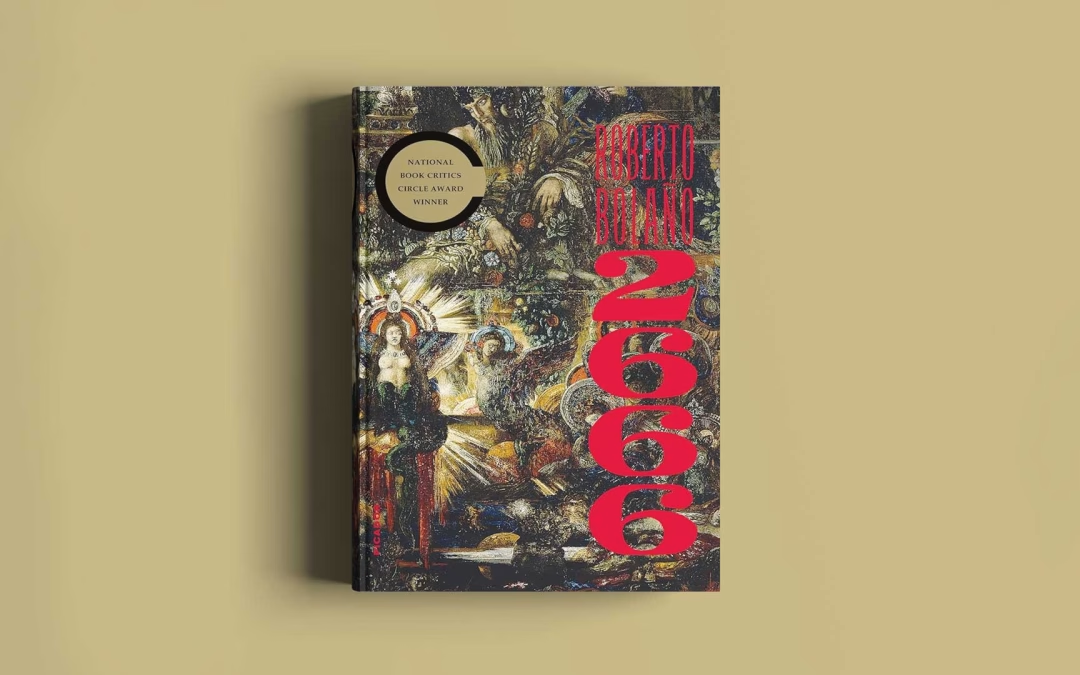
I'm going to be honest. This is a book I held in my hands for a long time before I opened it. Eleven hundred pages will do that. The spine alone looks like a building. But once I started reading, the size stopped mattering. The book gets bigger as you go in, not smaller.
2666 is the final novel by the Chilean writer Roberto Bolaño. He wrote it while he was sick and waiting for a liver transplant. He died in 2003 at the age of fifty. The book came out in Spanish in 2004, and Natasha Wimmer's English translation arrived in 2008. Wimmer won the PEN Translation Prize for the work. Read her version and you understand why.
2666 is literary fiction, but the kind that refuses to sit still. There are stretches that read like a campus comedy. Stretches that read like a noir. Stretches that read like a forensic report. Stretches that read like a war novel. Bolaño builds the book in five parts, and each part could almost have been its own novel. He originally wanted to publish them as five separate books, partly so his children would have steadier income from the royalties. His heirs decided to keep it as one. So there it is. One book. The size of a doorstop. The contents of a small library.
The book starts as four European literary critics build their entire careers around a reclusive German novelist named Benno von Archimboldi. They know his books backwards. They have never met the man. They have barely seen a photograph of him. Then a tip points them toward a Mexican border town called Santa Teresa, a fictional stand-in for Ciudad Juárez, and they go looking.
What they find, or rather what the book finds around them, is Santa Teresa itself. A factory town. A border town. A town where young women have been disappearing and turning up dead, and where the killings show no sign of stopping. The novel widens out from there. A Chilean philosophy professor and his daughter. An American sportswriter sent down to cover a boxing match. A long catalogue of crimes. And always, in the background, the German novelist the critics came here looking for.
That is as far as I will take you. The five parts braid together in ways you should discover on your own time.
Here is what others have said about it, in their words.
James Wood, in The New York Times Book Review, called Bolaño "one of the greatest and most influential modern writers." Jonathan Lethem, also in the Times, called the book "a landmark in what's possible for the novel as a form." Henry Hitchings in the Financial Times wrote that "Bolaño redraws the boundaries of fiction," and that the book "kicks away the divide between playfulness and seriousness." Amaia Gabantxo, in the Times Literary Supplement, called it "an exceptionally exciting literary labyrinth." The Complete Review gave it their A+ rating and called it "the first great book of the twenty-first century."
2666 won the National Book Critics Circle Award for Fiction in 2008. The New York Times Book Review named it one of the ten best books of that year. The Times later placed it at number six on its list of the 100 Best Books of the 21st Century. Oprah recommended it before the English translation had even hit shelves.
A few practical notes if you are thinking about starting it.
The book is long but it is not slow. The sentences move. Wimmer's translation is propulsive in a way that long novels are usually not. You can read it in five sittings, one part at a time, and the breaks help. The fourth part, which deals most directly with the murders in Santa Teresa, is the hardest section to sit with. It is also where Bolaño's purpose comes most clearly into focus. He does not look away. He does not let you look away either.