
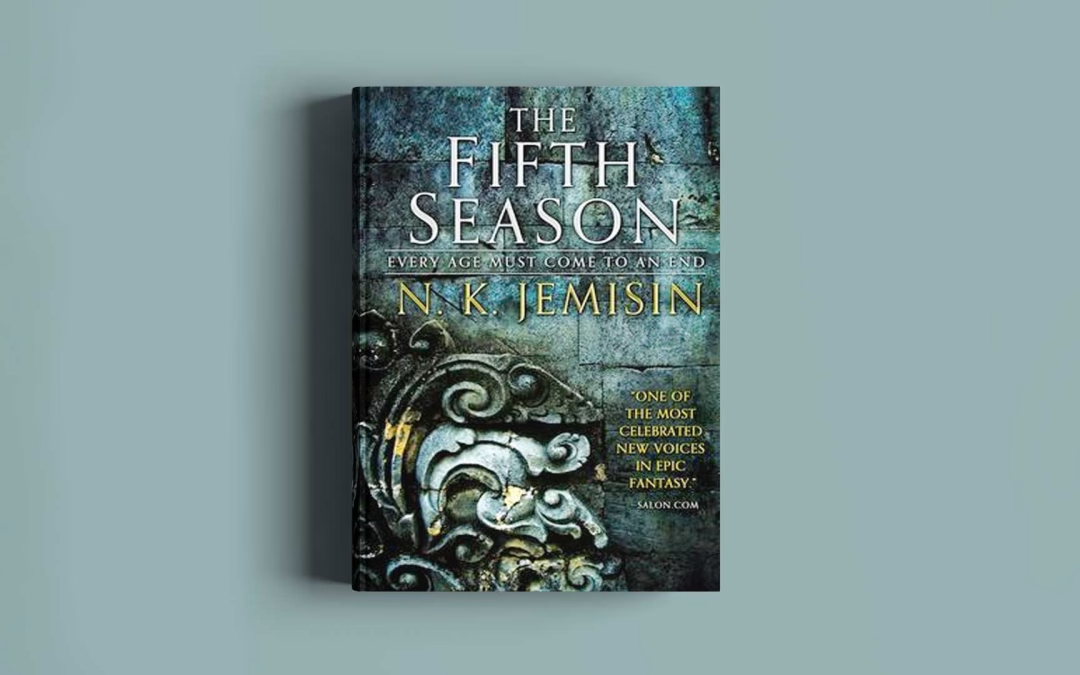
The world is ending. Again. On a planet called the Stillness, which is anything but, civilizations rise and fall on a geological clock, every few centuries shattered by a Fifth Season of climate catastrophe and ash-blotted skies. Three women carry the story. A middle-aged woman whose son has just been beaten to death by his own father and whose daughter has been taken. A young girl being marched away from her parents by a Guardian because she has been discovered to have powers no one in this world is allowed to have. And a rising star at the Fulcrum, the imperial institution that controls people like her, who is being forced into a mission and a partnership she did not choose. Jemisin won the Hugo Award for Best Novel for this book, then won it again for the sequel, then won it again for the third volume. No one had ever done that before. Once you read the first chapter you understand why.
About the Author
N. K. Jemisin was born in Iowa in 1972, raised in Brooklyn and Mobile, and trained as a counseling psychologist before she became a full-time novelist. Her debut, The Hundred Thousand Kingdoms, came out in 2010 and was nominated for almost every major award in the genre. The Fifth Season arrived five years later and changed the conversation. She is the first Black writer to win the Hugo Award for Best Novel, the first writer of any background to win it three years in a row, and the first to win it for every book in a single trilogy. In 2020 she received a MacArthur Fellowship. In 2025 the Science Fiction and Fantasy Writers Association named her a Damon Knight Memorial Grand Master, the highest lifetime honor in the field, an honor previously given to Ursula K. Le Guin and Octavia Butler. She is, by any reasonable measure, the most important science fiction writer of her generation. She also writes comics. Far Sector, her run on Green Lantern, won her a fifth Hugo in 2022.
Why It's Worth Your Time
The premise reads like fantasy. The execution reads like literary fiction. Jemisin built a world with the granularity of an anthropology paper, complete with caste systems, geological vocabulary, and an entire racial slur (rogga) used against people with elemental powers, and then she structured the novel as a triple braid of three women's lives that the reader slowly realizes are not three women at all. The plot machinery is extraordinary. So is the prose. One of the three storylines is told in the second person, present tense, which sounds like a gimmick on paper and turns out to be one of the most emotionally devastating choices in recent science fiction. The book is also, openly, an argument. It is about what a society does to people it has decided are dangerous. It is about parents and children. It is about how oppression reproduces itself through institutions that present themselves as merciful. It is also about ending the world, and whether ending the world might, under certain conditions, be the most ethical thing a person could do. If you have spent years being told that genre fiction cannot be serious literature, this is the book to hand the person who told you.
Before You Start
A few practical things. The Fifth Season is the first book of a trilogy, and the trilogy is one continuous story rather than three loosely connected novels. If you finish the first book and feel the floor drop out, the good news is that The Obelisk Gate and The Stone Sky are already on the shelf waiting for you. Most readers read all three back to back. Plan accordingly. The first sixty pages ask you to absorb a lot of vocabulary without explanation, including orogene, Guardian, comm, use-caste, and Fifth Season itself. Trust Jemisin. She is teaching you a language, and by the end of the first act, you will be fluent. The Orbit paperback is the standard edition, and the audiobook narrated by Robin Miles is exceptional, possibly the best audiobook performance of any genre novel in the last decade. If you are new to Jemisin, the Broken Earth trilogy is the place to start, and How Long 'Til Black Future Month is the short story collection to read after. Welcome to the Stillness. It will not be kind to you. You will not want to leave.