
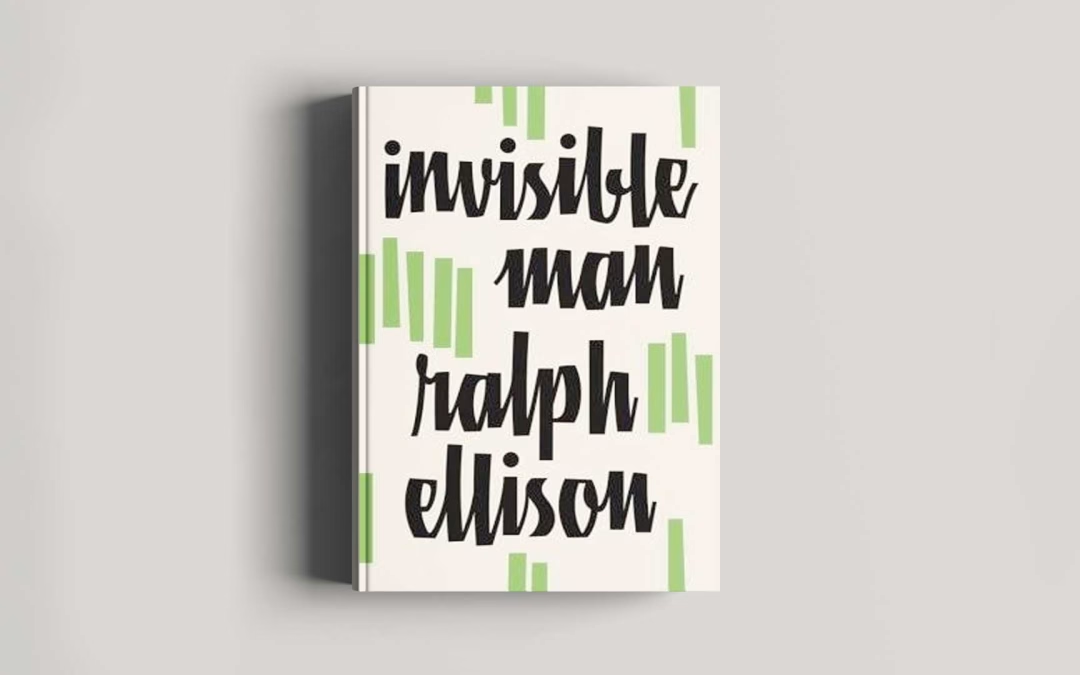
The narrator has no name. He is telling his story from a basement somewhere in Harlem, in a room he has wired with 1,369 light bulbs, all running on stolen electricity, all turned on at once. How he got there is the novel. He grew up in the segregated South, won a scholarship to a Negro college on the strength of a humiliating speech delivered after a humiliating fight staged for the entertainment of local white businessmen, got himself expelled for showing a visiting white trustee what Black life in the South actually looked like, and went north to New York thinking he was beginning his life. He was not. What he was beginning was a long, strange education in how many different ways a man can be looked through. Ellison's first and only completed novel won the National Book Award in 1953 and has not been out of print since.
About the Author
Ralph Ellison was born in Oklahoma City in 1913 and grew up wanting to be a symphony composer. He studied music at the Tuskegee Institute on a scholarship, made it through three years, and went to New York in 1936 expecting to earn enough money to finish his degree. He never went back. In New York he met Richard Wright, who pulled him toward writing, and within a few years Ellison was publishing essays and short stories and slowly, painstakingly, building the novel that would become Invisible Man. It took him seven years. When it appeared in 1952 it stayed on the bestseller list for sixteen weeks and won the National Book Award the following year, beating Hemingway's The Old Man and the Sea in the process. Ellison spent the rest of his life working on a second novel that he never finished. He died in 1994. The unfinished manuscript was eventually shaped by his literary executor into two posthumous books, Juneteenth and Three Days Before the Shooting..., but the canonical Ellison is the one novel, the two essay collections (Shadow and Act and Going to the Territory), and the influence he had on almost every Black American writer who came after him.
Why It Endures
More than seventy years after publication, Invisible Man keeps showing up at the top of every serious list of the great American novels, and it deserves the position. Part of the reason is the prose itself, which is genuinely virtuosic. Ellison was reading Dostoevsky, Joyce, and T. S. Eliot's The Waste Land while he wrote, and you can hear them in the book, but you can also hear the blues, jazz improvisation, the rhythms of Black Southern preaching, and the syncopated half-comic half-tragic voice of a man telling you a long story over a long night. The book is funny. People sometimes forget how funny it is. It is also a furious book, and a heartbreaking one, and an architectural marvel. The episodes (the battle royal in the prologue, the paint factory, the eviction in Harlem, the Brotherhood, the Harlem riot) are individually so famous that they get taught as standalone set pieces, but the novel itself is a single sustained argument about what it means to be seen. The final line still lands like a hand on the shoulder. "Who knows but that, on the lower frequencies, I speak for you?" Ellison was writing about the specific experience of being a Black man in mid-century America, and he was also writing about everyone who has ever felt looked through by the world. Both readings are correct. Both readings are why the book endures.
Before You Start
A few practical things. Invisible Man is long, just over five hundred pages in most editions, and it is structured as a series of escalating set pieces rather than a single forward-driving plot. Give it room to breathe. The opening prologue is dense and a little hallucinatory. If you find yourself disoriented in the first ten pages, do not panic. That disorientation is the point, and chapter one resets the clock and starts the story in a more conventional mode. Some readers prefer to go back and reread the prologue after finishing the novel, when the basement makes sense. Both approaches work. The Vintage paperback is the standard edition, and the audiobook narrated by Joe Morton is one of the great audio performances of an American novel. If this is your first Ellison, follow it with Shadow and Act, his 1964 essay collection, which is the best companion to the novel and an essential book on American music in its own right. After that, the natural next stops are James Baldwin's Go Tell It on the Mountain and Toni Morrison's Song of Solomon, both of which are in conversation with Ellison whether they say so or not.