
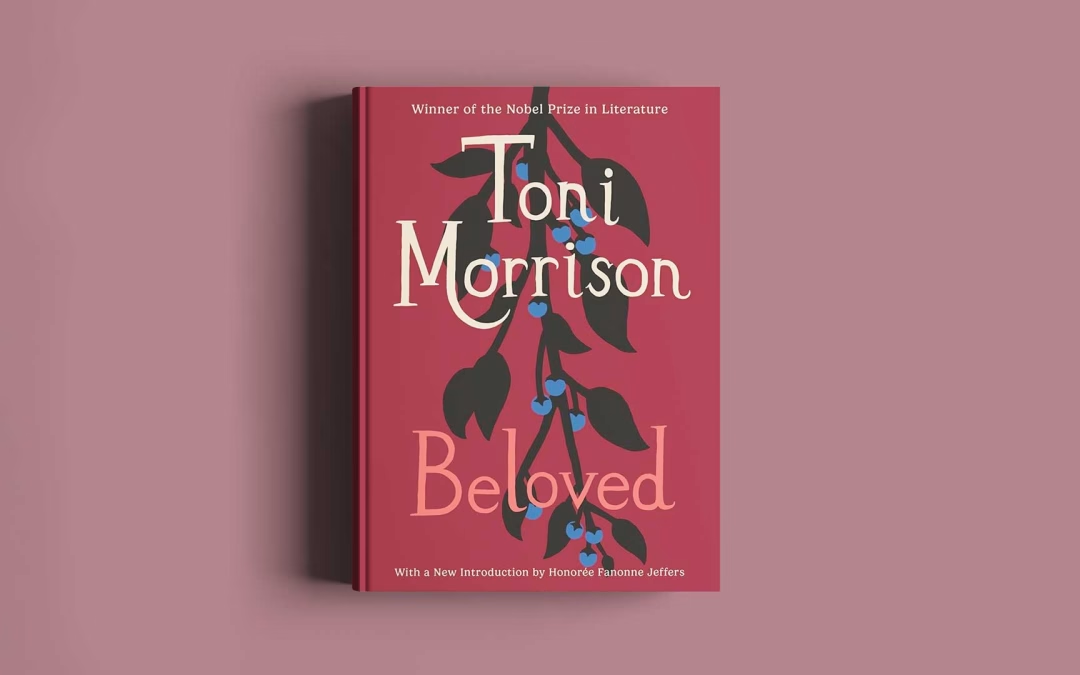
Sethe escaped slavery and made it across the Ohio River to a small house outside Cincinnati, but the past has followed her there, and one day a young woman calling herself Beloved appears at the door. What unfolds is a ghost story, a mother's reckoning, and a demonstration of what American prose can do when it refuses to flinch from either tenderness or terror. Sethe lives at 124 Bluestone Road with her daughter Denver and her mother-in-law Baby Suggs; into this haunted, half-broken household comes Paul D, a man who knew Sethe back at Sweet Home, the farm whose name was always a lie. The novel moves between memory and present, lullaby and indictment, and asks what it costs to keep the past at arm's length. What it costs when you can't.
"Read it and tremble." — People
About the Author
Toni Morrison published eleven novels between 1970 and 2015, beginning with The Bluest Eye and ending with God Help the Child. She won the National Book Critics Circle Award and the Pulitzer Prize for Beloved, and in 1993 she received the Nobel Prize in Literature. She died in 2019, leaving behind a body of work that has permanently shaped American fiction. Her sentences are built like music, phrases turning back on themselves, refrains repeating with small, devastating variations. Before she was a novelist she was an editor at Random House, where she spent nearly two decades shaping the careers of other writers and the shape of the catalog itself. Once you have read Morrison, you can recognize her in a paragraph: the rhythm of it, the patient accumulation of detail, the way a single image can hold an entire history.
"A play of human voices, consciously exalted, perversely stressed, yet holding true." — The New Yorker
Why It Endures
Nearly forty years after its publication, Beloved has lost none of its strangeness or its force. It is taught in college seminars and reread by people who first encountered it as teenagers and didn't understand what hit them until years later. Morrison drew on the real 1856 case of Margaret Garner, an enslaved woman whose decisions at the moment of her recapture became the seed of this novel. Morrison was after something larger than historical reconstruction. She wanted to give the dead their interior lives back. She has said she wrote the book in part because the interior experience of slavery had been crowded out of American literature, and she set out to make a novel that could not be crowded out. The result is at once intimate and enormous, a haunting in both the literal and the literary senses, told in language that rewards slowness. It is the kind of novel where you finish a sentence and have to set the book down for a minute before you can keep going. The 1998 film adaptation, with Oprah Winfrey as Sethe and Danny Glover as Paul D, is worth seeing afterward, though the novel does what only the novel can.
"I can't imagine American literature without it." — John Leonard, Los Angeles Times
Before You Start
Beloved is short,under 350 pages in most editions, but it is not a fast read, and it shouldn't be. The opening is famously disorienting: the novel drops you into 124 Bluestone Road mid-thought, and Morrison trusts you to find your footing. Trust her back. The pieces cohere. Be patient with the chronology; Morrison gives you the present and lets the past arrive in fragments, the way memory actually arrives. By the final third, the fragments line up, and the effect, when it does, is unforgettable. If you have time to read it twice, the second pass is where the architecture reveals itself; if you only read it once, read it slowly. A reading group or a friend to talk to about it helps. So does a good edition — the Vintage paperback with Morrison's own foreword is the standard one, and the foreword itself, written years after the novel, is worth the price of the book.