
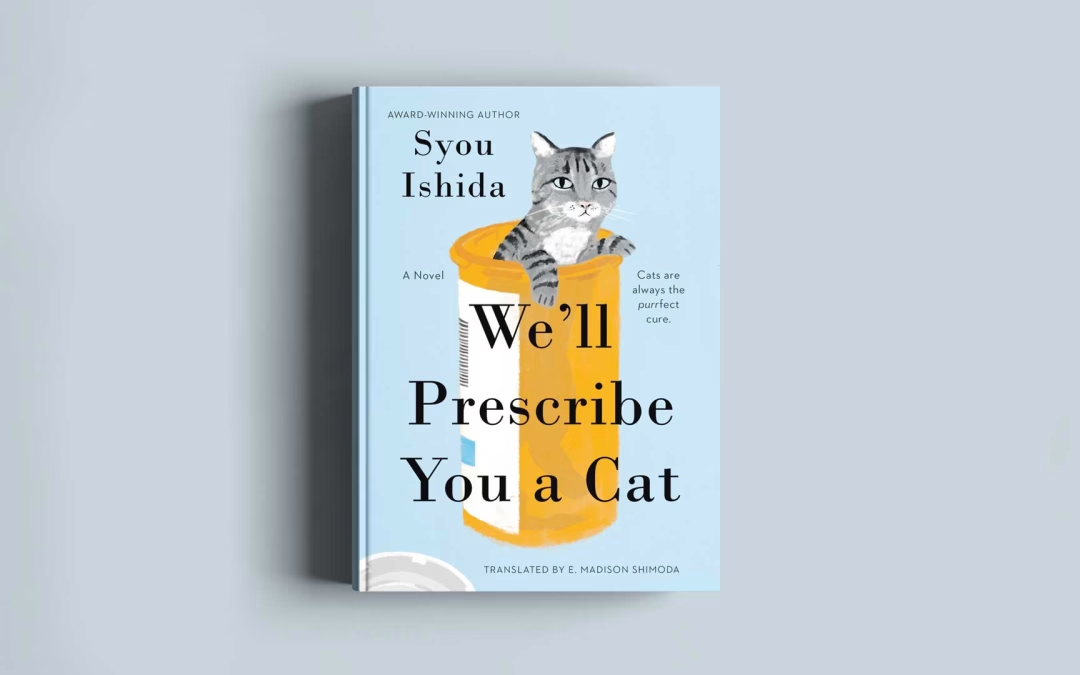
In an old building at the end of a narrow alley in Kyoto, there is a clinic. You cannot find it by looking. You can only find it when your life has gone sideways enough that you genuinely need help. When you finally do find it, the doctor inside listens carefully, then writes you a prescription. The prescription is a cat. The patients in this novel include a burned-out salaryman, an eleven-year-old girl trying to survive elementary school politics, a middle-aged man losing his footing at work and at home, a hardened handbag designer, and a geisha still grieving the cat she lost years ago. Each one goes home with a small furry stranger. Each one is changed by the experience in ways that have very little to do with cats and almost everything to do with paying attention.
"Six imaginative and whimsical stories about the animal-human bond. These stories need telling." — New York Journal of Books
About the Author
Syou Ishida was born in Kyoto in 1975 and started writing fiction while working at a telecommunications company, which is itself a small piece of evidence that the day job is not always the end of the story. We'll Prescribe You a Cat was a runaway bestseller in Japan and is being translated into seventeen languages. The English edition was a USA Today bestseller and has done the kind of word-of-mouth numbers that publishers spend whole careers hoping for. Ishida belongs to a wave of contemporary Japanese fiction that has found a global audience by being unhurried, kind, and quietly strange. Think of Toshikazu Kawaguchi's Before the Coffee Gets Cold, Sosuke Natsukawa's The Cat Who Saved Books, Michiko Aoyama's What You Are Looking For Is in the Library. There is a name for this corner of the bookshop now. "Healing fiction" is the rough translation. The books are short. They are warm. They take the small troubles of ordinary people seriously. Ishida's is one of the best of them.
"Best read with your own pet snuggled up by your side." — People
Why It's Worth Your Time
The premise sounds whimsical, and it is, but the book itself is doing something more interesting than the back cover lets on. The six linked stories are really about loneliness. The burnout that makes you forget you have a body. The way an eleven-year-old can be more sophisticated about social cruelty than her parents realize. The slow erosion of mattering. The cats are not metaphors, exactly. They are themselves, complete with bad attitudes, hairballs, and the specific way they sit on whatever you are trying to read. What the cats do, in story after story, is force their patients out of their own heads and back into the present tense of a living creature that needs feeding at six in the morning whether you feel like getting up or not. That is the medicine. The book is the kind of thing you can read in a weekend and then keep on your nightstand for whenever life gets thin. It is also genuinely funny in places. The cats have opinions. The doctor is not who you expect. The pharmacist is even less who you expect. By the last story, you will probably want a cat. If you already have a cat, you will probably go find them.
"Ishida's attentive prose captures cats' eccentricities, majesties, and quirks." — Tupelo Quarterly
Before You Start
A few practical things. This is a book of linked short stories rather than a single continuous novel, which means you can read it one chapter at a time before bed without losing the thread. Each story stands on its own, and the clinic is the connective tissue. If you like it, the good news is that Ishida has written a sequel in Japanese, Itsuka, Kitto, Neko ni Aeru, and English readers should expect it before long. While you wait, the closest cousins on the shelf are Kawaguchi's Before the Coffee Gets Cold, Natsukawa's The Cat Who Saved Books, and Hiro Arikawa's The Travelling Cat Chronicles. The Arikawa is especially good if this one breaks your heart in the right way and you want more of that feeling. As for editions: the Berkley paperback is the standard English version, and the audiobook is a pleasant listen for a commute. Just maybe not on a day you need to keep your composure in public. A few of these stories will get you.