
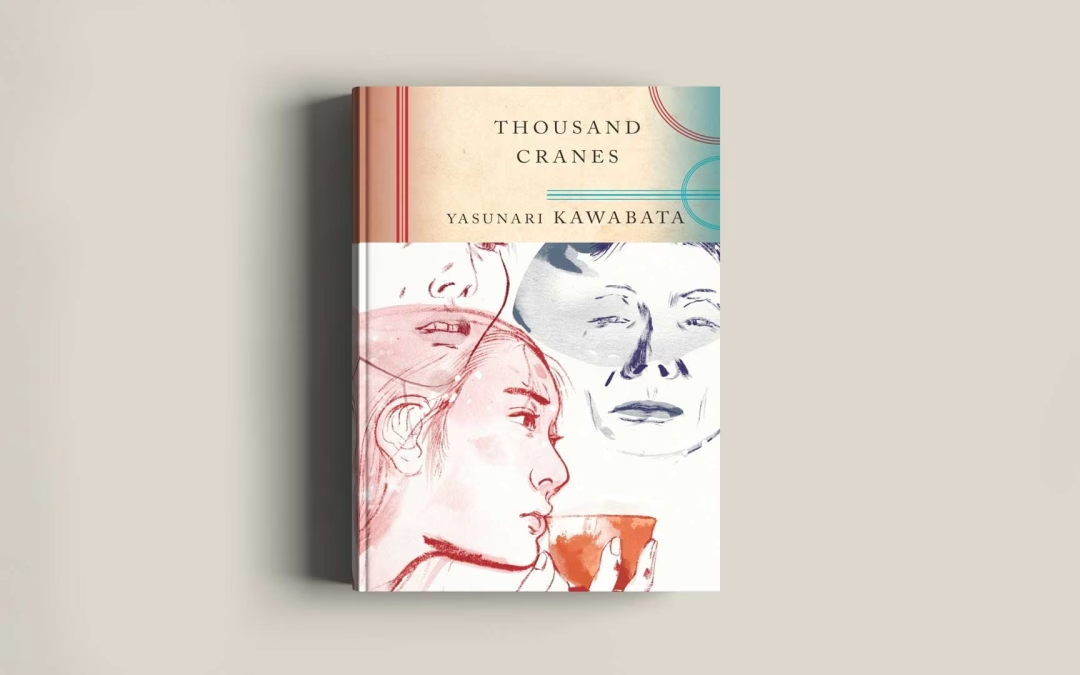
Kikuji is a young Tokyo office worker, twenty-eight years old, both of his parents recently dead. He has been invited to a traditional tea ceremony hosted by Chikako Kurimoto, a woman with whom his late father once had a brief, badly ended affair. At the ceremony he meets two other women. One is a young woman of grace and reserve carrying a silk furoshiki patterned with a thousand cranes. The other is Mrs. Ota, his father's long-time mistress, accompanied by her daughter Fumiko. What follows is a quiet, terrible, beautifully restrained novel about inheritance, about desire that arrives in the wrong rooms, and about how a son can find himself living inside his father's old life without ever quite meaning to. Kawabata won the Nobel Prize in 1968. This is one of the three novels the Nobel committee named when they gave it to him.
About the Author
Yasunari Kawabata was born in Osaka in 1899. By the time he was fifteen he had lost his father, his mother, his grandmother, his sister, and his grandfather, and the experience of being orphaned so thoroughly and so young shaped almost everything he wrote afterward. He published his first stories while still in high school. By the late 1920s he was already a central figure in Japanese letters. His most famous novels, Snow Country, Thousand Cranes, The Sound of the Mountain, The Master of Go, and Beauty and Sadness, are among the defining works of twentieth-century Japanese literature. In 1968 he became the first Japanese writer to win the Nobel Prize in Literature. The Swedish Academy cited his "narrative mastery, which with great sensibility expresses the essence of the Japanese mind." He served for years as the head of Japanese P.E.N. and mentored a younger generation of writers, including Yukio Mishima. He died in 1972, by his own hand, in the seaside resort town of Zushi. The English translations by Edward G. Seidensticker, who also translated Tanizaki and The Tale of Genji, are the ones almost every English reader knows. They are remarkable.
Why It Endures
Thousand Cranes is short, fewer than 150 pages in most editions, and the surface of the prose is so calm that on a first read you can miss how much is happening underneath. The novel is structured around objects. A tea bowl. Another tea bowl. A jar. A furoshiki. Each one carries memory, association, and ownership history, and the way each one passes between characters is the actual plot. Kawabata trusted that a reader could feel the weight of a ceramic vessel and understand, without being told, that the lipstick stain on its rim represented a love affair that ended thirty years ago and is still warping the lives of everyone who handles it. The novel is also, interestingly, not what Western readers often assume it to be. Kawabata himself said publicly that the book was not a celebration of the tea ceremony but a warning, a "negative work" about the vulgarity into which a sacred ritual had fallen. The tea ceremony in this novel is in the hands of someone who has weaponized it. The objects are gorgeous. The people using them are not always good. That tension is the engine of the book. For readers who love Yoko Ogawa, Marguerite Duras, or the late novels of Henry James, this is essential reading. For readers who think nothing happens in literary fiction, this is the novel to read by lamplight and see what happens when nothing is happening as loudly as possible.
"A stunning economy, delicacy of feeling, and a painter's sensitivity to the visible world." — The Atlantic
"A poet of the gentlest shades, of the evanescent, the imperceptible." — Commonweal
"Rich suggestibility, and a story that is human, vivid and moving." — New York Herald Tribune
Before You Start
A few practical things. Thousand Cranes originally appeared in serialized form in Japanese magazines between 1949 and 1951 and was published as a single volume in 1952. It is best read slowly. The book is not difficult, exactly, but it is allusive, and the things it is most interested in are the things it does not say out loud. If you find yourself wondering whether you missed something on page sixty, the answer is probably yes, and the right move is to go back and reread the previous chapter. You will find what you missed. The Vintage paperback with the Seidensticker translation is the standard English edition. If you love it, the natural follow-ups are Kawabata's Snow Country, which is the earlier novel and a useful companion piece, and The Sound of the Mountain, which many readers (and some critics) consider his masterpiece. After Kawabata, the obvious next stop is Junichiro Tanizaki, especially The Makioka Sisters. For a contemporary Japanese writer working in a related register of quiet and devastating, Yoko Ogawa's The Housekeeper and the Professor makes a beautiful pairing. Read this one in the afternoon, with tea. Real tea. The book will know.