
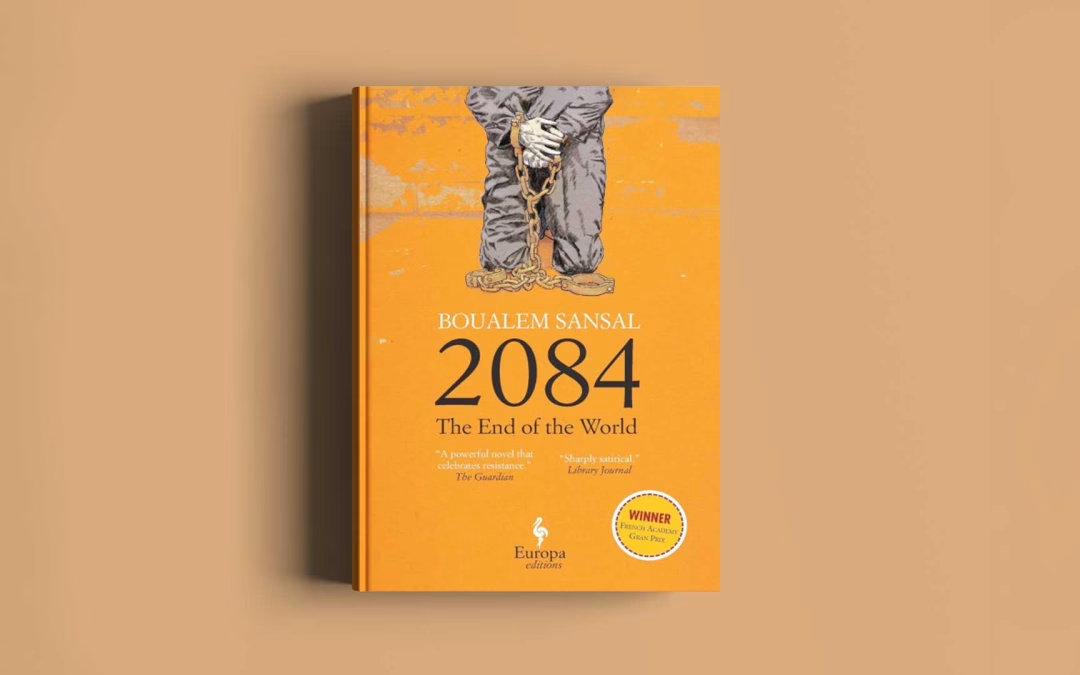
Every dystopia is in conversation with the one before it. Huxley was talking back to Wells. Orwell was talking back to both of them. Atwood was talking back to Orwell. And 2084, the title alone, tells you exactly which conversation Boualem Sansal wants to enter.
This is the Algerian writer's tribute to Nineteen Eighty-Four, set one hundred years after Orwell's novel. It came out in French in 2015 from Gallimard, won the Grand Prix du Roman de l'Académie française that same year, and was named the best book of the year by Lire magazine. Alison Anderson's English translation arrived from Europa Editions in 2017.
This is dystopian fiction in the older, properly political sense of the word. Not the YA-trilogy kind. The Zamyatin and Orwell and Huxley kind. The kind where the world-building is in service of an argument about the present, and where the protagonist's small private act of doubt is the whole hinge of the story. If you have a shelf for We and 1984 and Brave New World, this book belongs on it.
The year is 2084. The country is Abistan, a vast empire that claims to be the entire earth. Its people worship a single god named Yölah, whose sole earthly delegate was the prophet Abi, after whom the empire is named. Citizens kneel in prayer nine times a day. They speak a deliberately impoverished language called abilang, designed to shorten words and shrink thought. They are watched constantly. Remembering the time before is forbidden, because officially, there was no time before. History begins with the Great Holy War of 2084 against the Great Disbelief, in which hundreds of millions of martyrs are said to have died.
Heretics are stoned or beheaded in public squares. The citizens of Abistan are happy. They are told they are happy. Many of them are.
Ati is not.
Ati is a man recovering from tuberculosis in a sanatorium high in the mountains. While he is there, he begins to notice the shape of the thoughts he is not allowed to have. He begins to wonder whether there is anything outside Abistan. When he returns to the capital, he meets his friend Koa, and the two of them begin to look for the answer. Somewhere out in the ghettos and the fringes of the empire, they have heard, there are still people who think.
That is as far as I will take you.
Library Journal called the book "sharply satirical." The Guardian called it "a powerful novel that celebrates resistance." Lire described it as "a rare, powerful book," sitting "at the intersection of fable and lampoon, of satire and science fiction." The Times Literary Supplement praised Alison Anderson's "deft and intelligent translation," and described the book overall as "a moving and cautionary story." Marianne Payot of L'Express called it "a profound and frightening novel about a dictatorship without history." Jean-Louis Le Touzet of Libération warned that "readers will be swept away by Sansal's rhythm." Michel Abescat in Télérama wrote that "the fable is powerful, the humor, devastating, the subject, chilling."
2084 is shorter than Orwell. About 240 pages in the Europa paperback. It moves slowly on purpose. The Abistan that Sansal builds is meant to feel exhausting and airless, and the prose does the work of making you feel that air pressure on your chest as you read. Some readers find this a feature. Some find it a bug. The Académie française found it the book of the year.
It is also a book worth pairing with its source. If you have not read Nineteen Eighty-Four recently, or if you have only read it once, in school, reading them within the same month is its own kind of education. They illuminate each other in both directions.