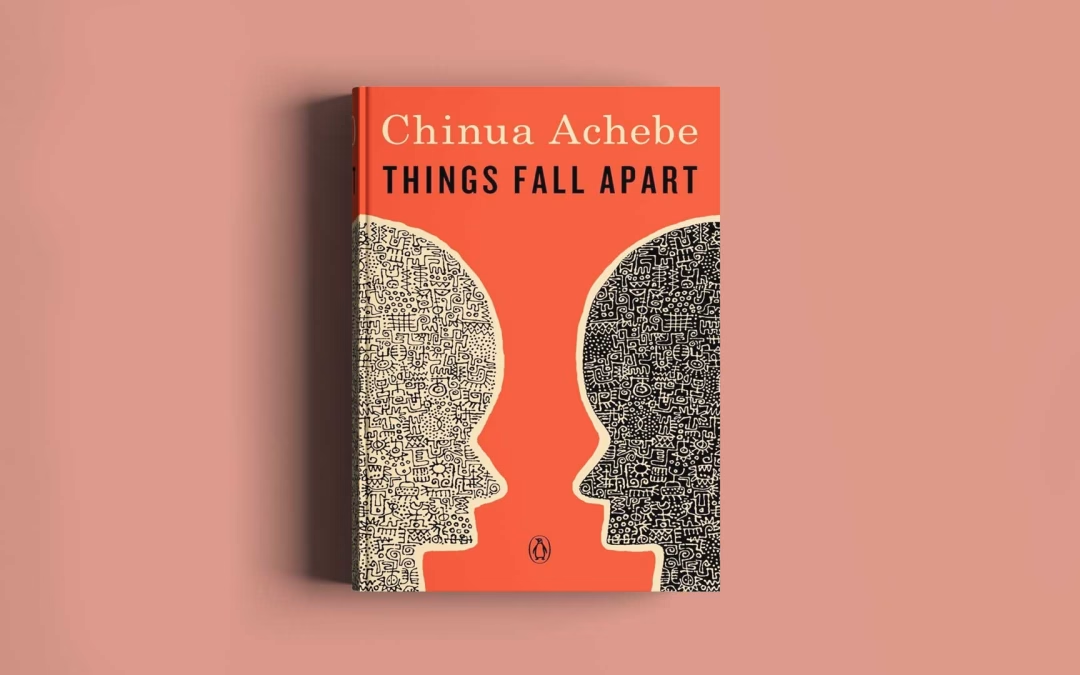
Okonkwo is one of the most respected men in Umuofia, a cluster of nine Igbo villages in what will eventually be called southeastern Nigeria. He is a wrestling champion. He is a yam farmer of standing. He has three wives, a barn full of seed yams, and a quietly terrified household. Everything he is, he built himself, in deliberate opposition to the memory of his father, who died poor and in debt. The novel follows Okonkwo through a series of decisions, some catastrophic, some merely human, and into the moment when British missionaries arrive in the next village over and begin doing something Umuofia does not yet have a name for. What unfolds is one of the great tragedies in world literature, and one of the great acts of cultural recovery. Achebe wrote it at twenty-six. He published it in 1958. Nothing has been quite the same since.
About the Author
Chinua Achebe was born in 1930 in Ogidi, in southeastern Nigeria, the son of an Igbo evangelist and his wife. He studied at the University of Ibadan, where he read the colonial novels about Africa that were standard in the curriculum and recognized, sentence by sentence, that the people in them did not resemble anyone he knew. He started writing Things Fall Apart while working at the Nigerian Broadcasting Corporation, mailed the only handwritten copy of his manuscript to a typing agency in London, heard nothing for months, and nearly lost the entire book before a colleague tracked it down covered in dust in a corner of the agency's office. Several publishers rejected it on the grounds that fiction by African writers had no financial future. Heinemann finally took it in 1958. It sold modestly at first and then steadily, then translated into more than fifty languages, then sold over twenty million copies, then settled into the position it has held ever since, which is as the foundational novel of modern African literature. Achebe went on to write No Longer at Ease and Arrow of God, which complete what is now called the African Trilogy, along with several other novels, essay collections, children's books, and a late, unsparing memoir of the Biafran war called There Was a Country. He taught for years at Bard and finished his career at Brown. He died in 2013. Toni Morrison's verdict on him is the one that lasts. "African literature is incomplete and unthinkable without the works of Chinua Achebe."
Why It Endures
Before Things Fall Apart, almost every novel set in Africa was written by a European, and the Africans in those novels were scenery. Achebe sat down to write a book in which the Africans were the people, with their own proverbs, their own religion, their own kinship structures, their own internal arguments about who they wanted to be. The first two thirds of the novel are spent inside Umuofia before the British arrive at all, and that long, patient immersion is the point. By the time the missionaries appear, the reader knows what is being lost. The book's title comes from Yeats, but the structure is Igbo. Achebe weaves proverbs into the prose so thoroughly that even readers without any prior context find themselves quoting them aloud. The argument is not that Igbo society was a paradise. Okonkwo himself is a difficult man, sometimes a cruel one, and the novel does not let him off the hook. The argument is that this was a world, a real and complete world, and that what colonialism did to it was a tragedy on a scale that English fiction had not previously been willing to acknowledge. The book has been listed on Time's 100 Best English-Language Novels, the BBC's 100 Most Influential Novels, and Britannica's 12 Greatest Books Ever Written. Barack Obama has called it a true classic of world literature.
Before You Start
A few practical things. Things Fall Apart is short, just under two hundred pages in most editions, and it can be read in a weekend. Do not let the brevity fool you. The book rewards slowness, and the proverbs in particular reward rereading. Achebe writes in English but threads Igbo words throughout. Most editions include a glossary at the back. Use it the first time through, and you will find by the end that you no longer need it. If you love this one, the natural next steps are the other two volumes of the African Trilogy, No Longer at Ease (Okonkwo's grandson, a generation later, working as a civil servant in colonial Lagos) and Arrow of God (set just before the events of Things Fall Apart, in a different community, with a different protagonist). After that, the Achebe essay you must read is "An Image of Africa," his 1975 lecture on Joseph Conrad's Heart of Darkness. It is one of the most influential pieces of literary criticism written in the twentieth century, and it pairs with this novel like coffee with bread. The Penguin Classics paperback is the standard English edition. Any library worth its name will have multiple copies. They will all be checked out. That is a good sign.