
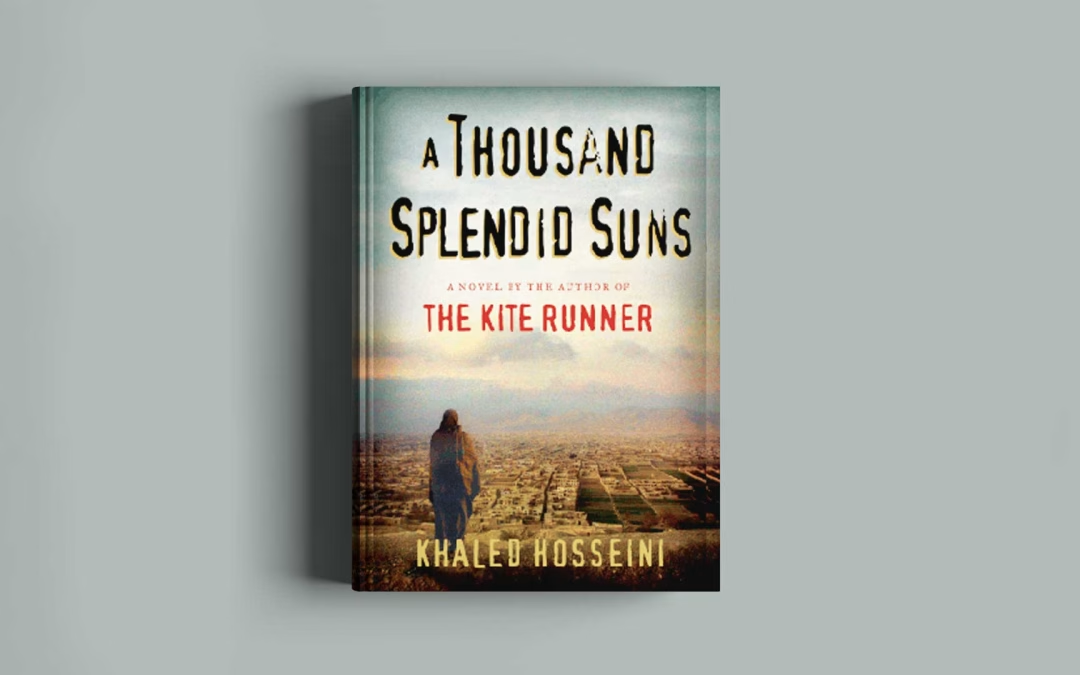
Mariam lives with her mother in a hut outside Herat, the illegitimate daughter of a wealthy man who visits on Thursdays and pretends she doesn't exist the rest of the week. At fifteen she is married off to a shoemaker in Kabul three times her age. Nearly two decades later, after a Soviet war and a civil war and the rocket that killed her parents, a fourteen-year-old girl named Laila ends up in the same house, married to the same man. Out of that shared cruelty, Mariam and Laila build the friendship that holds the rest of the novel together. Hosseini calls it a mother-daughter story. It also happens to be one of the most readable books ever written about Afghanistan.
"Dense, rich, pressure-packed guide to enduring the unendurable." – Lev Grossman, Time
About the Author
Khaled Hosseini was born in Kabul in 1965, the son of a diplomat and a teacher. The family was in Paris on a posting when the Soviets invaded in 1979, and they never returned home. They eventually settled in San Jose, California, where Hosseini went to medical school and practiced as an internist for almost a decade before publishing his first novel. The Kite Runner came out in 2003 and slowly became a global word-of-mouth phenomenon, selling more than thirty million copies. A Thousand Splendid Suns followed in 2007 and sold over a million copies in its first week. Hosseini is now a goodwill envoy for the UN Refugee Agency and runs a foundation that has spent the better part of two decades funding aid projects in Afghanistan. He writes patient, plot-driven, deeply emotional fiction. It is not fashionable in literary circles to admit you love Hosseini. Plenty of people do anyway.
"Stunningly heroic characters whose spirits somehow grasp the dimmest rays of hope." – Carol Memmott, USA Today
Why It Endures
The title comes from a seventeenth-century Persian poem about Kabul by Saib Tabrizi, and the line itself is doing quiet work all the way through the book. Hosseini began writing after a 2003 trip back to Kabul, where he kept noticing the burqa-clad women begging at street corners with three or four children in tow and finding himself unable to stop thinking about their lives. He wanted to write something that would give those women interiors. The novel covers nearly forty-five years of Afghan history, from the last days of the monarchy through the Soviet occupation, the mujahideen, the Taliban, and the early years of the American intervention. None of it is presented as a history lesson. It moves through Mariam's and Laila's kitchens and courtyards and bus rides, and the politics arrives the way politics actually arrives in most people's lives, which is through what it does to your family. Hosseini rewrote the manuscript five times before he was finished with it, and you can feel the patience of that revision in every chapter. The book has since been adapted for the stage at the American Conservatory Theater, turned into an opera commissioned by Seattle Opera in 2023, and named to the BBC's list of the hundred most inspiring novels.
Before You Start
A practical note. This is a book that does not look away from violence against women and children, including beatings, forced marriage, and the loss of a child. If those subjects are difficult for you right now, you may want to know that going in. The reward for reading through them is one of the most satisfying friendships in contemporary fiction. Mariam and Laila are, as Carol Memmott put it, stunningly heroic, and the relationship they build inside that house is the heart of the novel. If this is your first Hosseini, you do not need to have read The Kite Runner first. The two are companion pieces rather than a series, and you can read them in either order. Hosseini has described the first as a father-son story and Splendid Suns as its mother-daughter complement. Many readers prefer the second one. The Riverhead paperback is the standard edition, and the audiobook narrated by Atossa Leoni is excellent if you commute. Whichever way you read it, give yourself a clear evening for the last fifty pages. You will want them.