
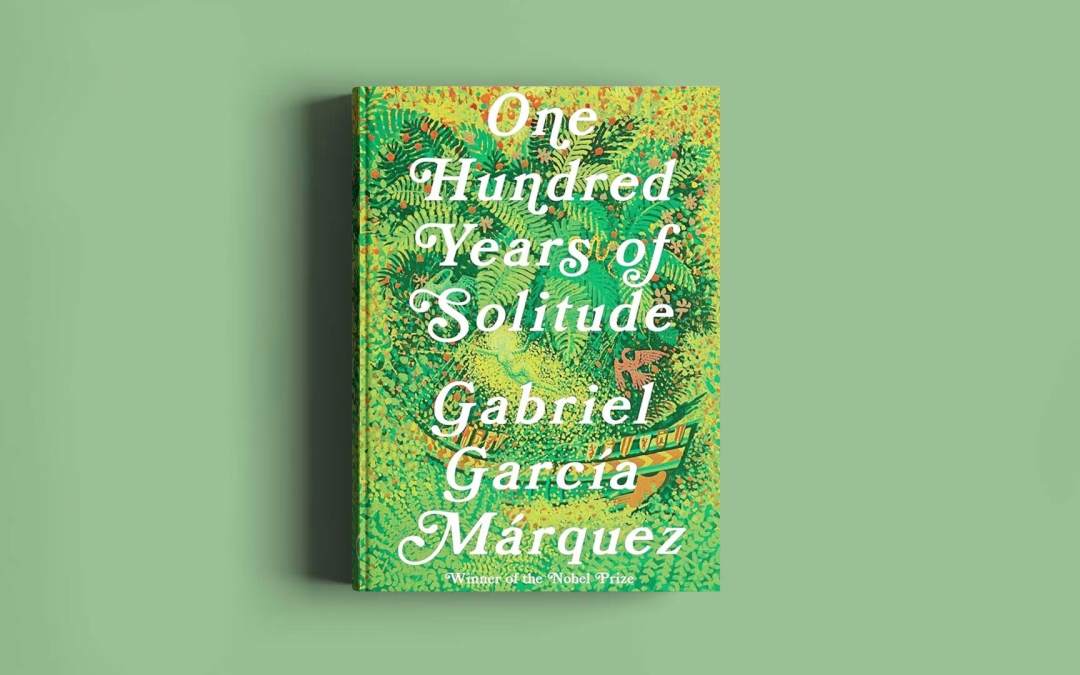
In the jungle town of Macondo, founded by the patriarch José Arcadio Buendía after a dream of a city of mirrors, seven generations of one family live out a century of love affairs, civil wars, banana plantations, prophecies, insomnia plagues, and ghosts who refuse to leave the house. García Márquez writes the whole saga as if he were telling you something that actually happened to his great aunt, with a tone so matter-of-fact that flying carpets and rains of yellow flowers feel about as remarkable as the weather. It is the kind of novel that ruins you a little for ordinary novels. Once you have lived in Macondo, plain realism can feel a bit thin by comparison.
"The greatest novel in any language of the last fifty years." – Salman Rushdie
About the Author
Gabriel García Márquez was born in 1927 in Aracataca, Colombia, the small Caribbean town that would later supply the dust and heat and folk magic of Macondo. He started out as a newspaper reporter, and you can feel it in his fiction. He has a journalist's eye for the telling concrete detail, married to the storytelling instincts of his grandmother, who told him tall tales with a perfectly straight face. He published the novels The Autumn of the Patriarch, Love in the Time of Cholera, and Chronicle of a Death Foretold, and he won the Nobel Prize in Literature in 1982. He remained until his death in 2014 the most widely read Spanish-language novelist of the twentieth century. Pablo Neruda called this book the greatest revelation in the Spanish language since Don Quixote. That is the company it keeps.
"You emerge from this marvelous novel as if from a dream, the mind on fire." – John Leonard, New York Times
Why It Endures
García Márquez famously spent eighteen months in a small room in Mexico City writing this novel, smoking sixty cigarettes a day, while his wife Mercedes held the family together on credit. When he finally mailed the manuscript to his publisher in Buenos Aires, he could only afford to send half of it at a time. The book sold out its first printing in a week. Nearly sixty years on, it has sold tens of millions of copies in dozens of languages, and almost every major novelist who has come after has had to reckon with it. Toni Morrison, Salman Rushdie, Junot Díaz, Isabel Allende, and Arundhati Roy have all named García Márquez as a writer who showed them what fiction could do. The reason it endures is not really the magic. It is the seriousness underneath the magic. The Buendías live through colonization, civil war, foreign capital, massacre, and forgetting. The novel is a comic masterpiece, and it is also a quiet, devastating argument about what nations choose to remember and what they let themselves forget.
Before You Start
A practical warning: every male in the Buendía family is named either José Arcadio or Aureliano, sometimes both at once, and there are a lot of them. Most editions print a family tree at the front of the book. Use it. Some readers keep a finger in it like a bookmark for the first hundred pages, and there is no shame in that. The novel rewards patience with the names and trusts you to settle into its rhythm. The Gregory Rabassa translation, which García Márquez himself called better than the original, is the one almost every English reader knows, and it is the one to start with. There is also a recent Netflix adaptation in Spanish, produced with the cooperation of the García Márquez estate. Watch it after you read the book, not before. Part of the pleasure of Macondo is letting it appear in your own head first, exactly as García Márquez built it, one strange and ordinary sentence at a time.