
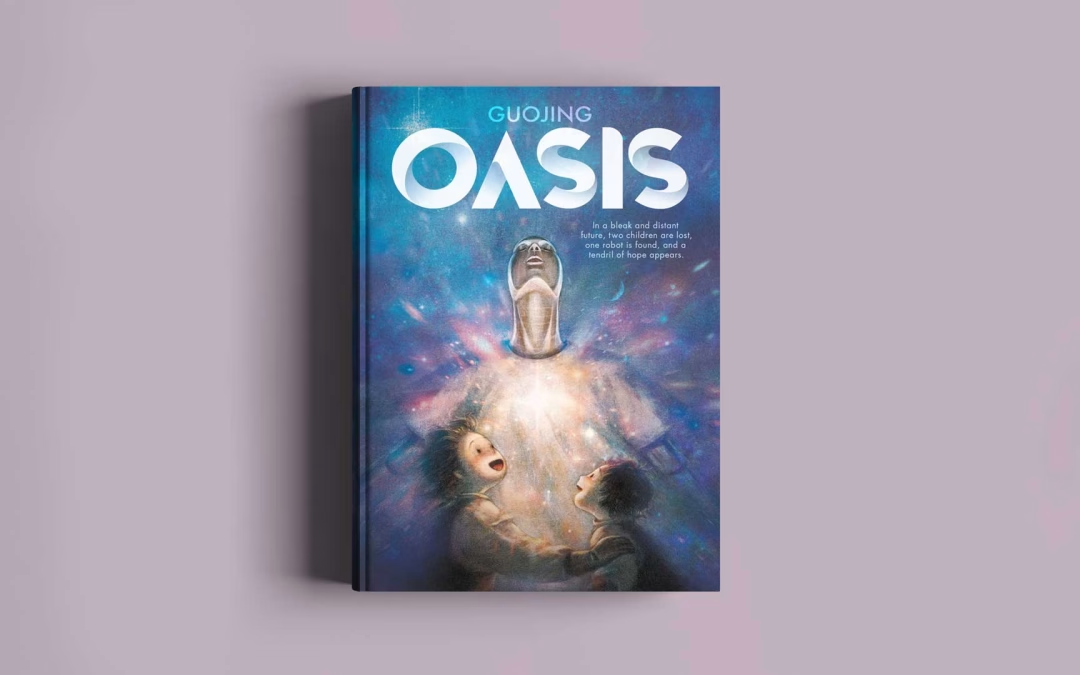
A girl. Her little brother. A robot they find in a junkyard. A desert that stretches in every direction. A city, somewhere out past the horizon, that may or may not let them in.
That is the shape of Oasis, the fourth graphic novel by the Canada-based author and illustrator Guojing. Her debut book, The Only Child, was named a New York Times best illustrated book of the year. This one, Oasis, has picked up seven starred reviews and landed on Best Book of the Year lists at The New York Times, NPR, and Publishers Weekly.
This is a graphic novel, set in a near-future science fiction landscape, told almost entirely through pictures. The book is for ages eight to twelve, but the way that age range works in graphic novels is generous. Plenty of adult readers will read it, and many will cry. If you have a shelf for The Wild Robot by Peter Brown, or for A Rover's Story by Jasmine Warga, this book belongs near them. The publisher's own copy makes both comparisons explicitly. They are accurate.
A girl named JieJie and her little brother DiDi are living alone in a barren desert. Their mother is somewhere else, working long hours, trying to earn the family's admission into a place called Oasis City. The kids weather sandstorms. They scavenge for water. They look after each other. DiDi develops eczema. JieJie figures out how to take care of him. The days are slow and hot and difficult, and the two of them have only each other.
Then, in an abandoned junkyard, they find a robot. It is dormant. They wake it up.
What happens after that is the rest of the book, and the rest of the book is yours.
The New York Times wrote that the book is "thought-provoking and haunting" and that it "feels like it's welcoming the reader with a warm hug." Booklist, in a starred review, called it "this deeply compelling fable." Kirkus, in another starred review, wrote that "the children are at the heart of the narrative," and that "the family they form, unconventional as it may be, offers a breath of hope in a dark time."
Guojing has said in interviews that the story was inspired by what are called left-behind children, kids in China, the Philippines, and other countries whose parents leave home for city work and who are raised by grandparents or, in some cases, by no one at all. The desert in this book is not the real desert. The city in this book is not the real city. But the feeling of waiting for a parent who is working somewhere you cannot see is real, and it is the engine of the whole story.
The art is soft, gray, and quiet. Pencil and toner, monochrome, with uncluttered panels. There are full-page spreads where almost nothing happens and yet the spread takes your breath. You will want to read this book slowly. Resist the urge to flip. Sit with each page. The book is short by page count and long by feeling.
The moon shows up often. In Chinese culture the full moon is a symbol of family reunion, and Guojing has said in interviews that she placed it deliberately. Food shows up often too. What the kids eat in the desert is one thing. What gets cooked when the family is together is another. Pay attention to whose hands make the food.
If you have kids in your life, this is a beautiful book to read together. The youngest readers will follow the plot through the pictures alone. The oldest readers will follow it through everything else.