
A body shows up on the outskirts of town. A young woman. A singer. Forty days later, the country is on fire.
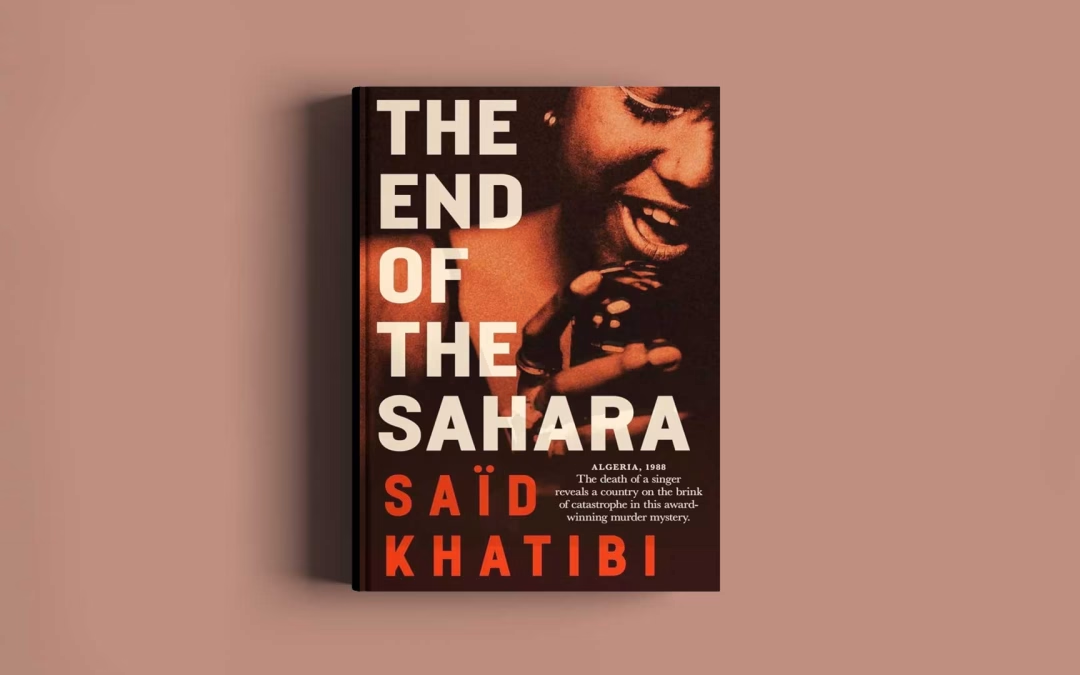
The End of the Sahara is the most recent novel by the Algerian writer Saïd Khatibi, translated into English from the Arabic by Alexander E. Elinson. It won the Sheikh Zayed Book Award in the Young Author category in 2023, and Khatibi's previous novel Sarajevo Firewood was shortlisted for the International Prize for Arabic Fiction in 2020. He has spent the last few years quietly becoming one of the writers people who read Arabic fiction tell other readers about.
This is a literary murder mystery, the kind that uses the bones of the detective novel to do something the detective novel does not usually try to do. Think of how Leonardo Padura uses Havana, or how Kamel Daoud reframes Camus from the other side. The whodunit is real. The investigation is real. But the engine underneath is sociological. The whole town is a suspect. So is the country.
It is early autumn 1988. The place is an unnamed provincial city on the edge of the Algerian Sahara, although you can practically smell where it is. Locusts have arrived. Food is scarce. The one-party socialist government is plainly running out of road. Protests are coming, and everyone in the book seems to feel them in their teeth without quite being able to name what is about to happen.
In a hotel called the Sahara, a young woman named Zakia Zaghouani sings to drinkers and travelers. She is beautiful. She is from somewhere else. She left her small hometown to make a different kind of life, and the new life has costs nobody quite wants to discuss.
Then a shepherd finds her body.
Her fiancé, a man named Bachir, is found with blood on his shirt. He goes to prison almost before anyone has thought to ask a question. The investigation falls to Inspector Hamid, who is corrupt and not particularly interested. The defense falls to Bachir's cousin Noura, a lawyer who is constantly told that she is too old to still be unmarried. Around these two are the hotel owner Maimoun, a wheeler-dealer who had a thing for Zakia, and Ibrahim, a college graduate now selling illegal videos because nothing else is on offer.
Each of them gets the microphone. The novel is told in first-person testimony, one suspect at a time, one witness at a time. Each voice you hear has a reason to have wanted Zakia gone. The book runs forty days, start to finish, and ends as the streets erupt.
That is as far as I will take you.
Here is what readers have said about it, in their words.
The Wall Street Journal called the book "cinematic, kaleidoscopic and tragic," and named it "a splendid achievement." NPR's Fresh Air called it "brilliant." CrimeReads called it "evocative, brooding, and perfectly hard-boiled." Publishers Weekly praised the "elegant prose and a keen sense of place" and called the book "a solid whodunit that doubles as a captivating look at a country in transition." The Financial Times listed it among its Best Thrillers of the Month, noting that "Alexander Elinson's translation from the Arabic feels lively and authentic." A starred review in Kirkus called it "an absorbing novel that should broaden Khatibi's following."
The book is short, roughly 250 pages depending on edition, and it moves. Reading it in two or three sittings is the natural pace. The first-person testimonies switch quickly, and the rhythm of those voices is part of the pleasure. Pay attention to who is being asked questions and who is volunteering information. Both kinds of speakers are lying about something.
If you have not read much Algerian fiction, this is a strong entry point. The setting is specific, the historical pressure is real, and you do not need a background in Algerian politics to follow it. The book hands you what you need as you go. The mass protests that erupt at the end of the novel are real, and worth a five-minute search after you finish.